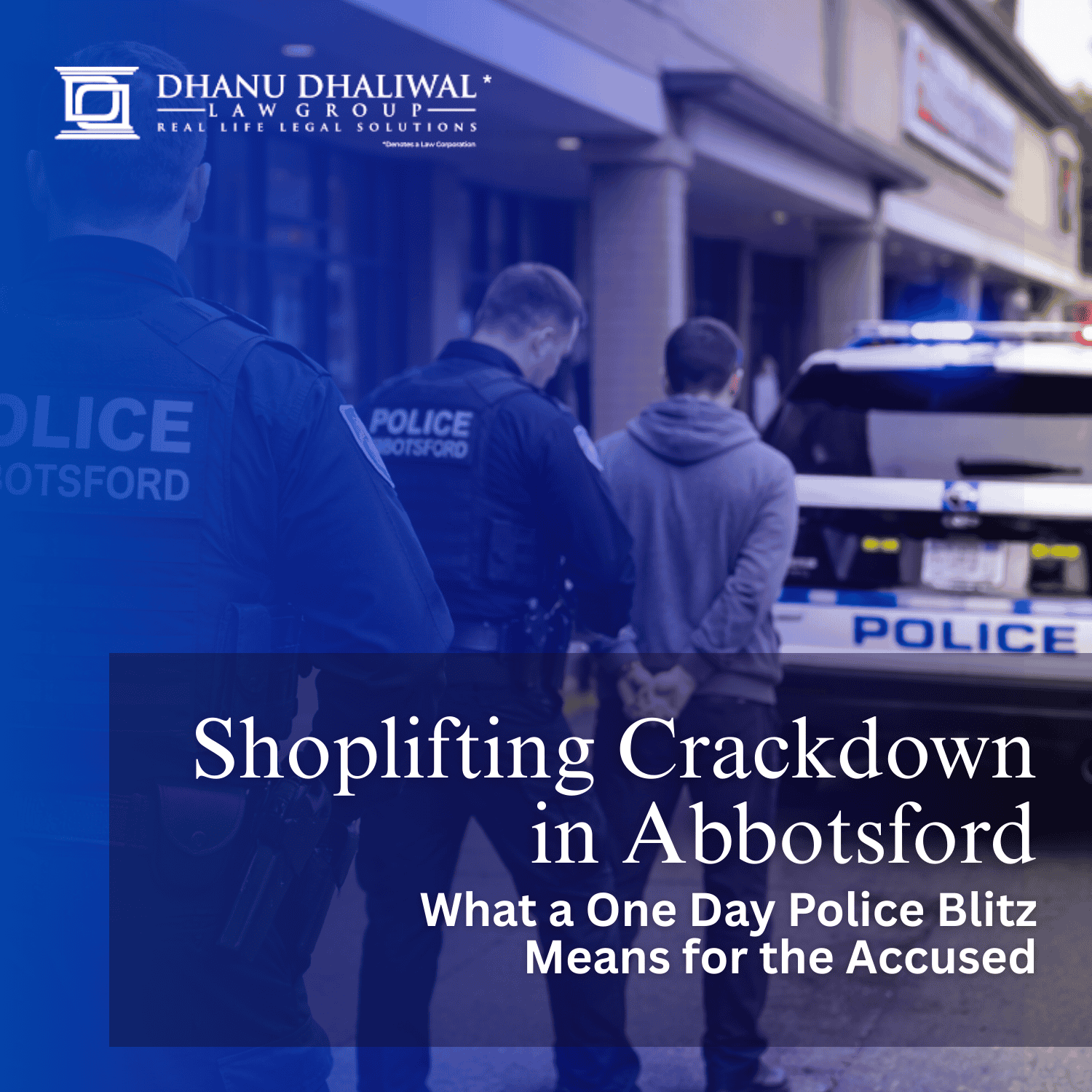
A recent one day retail theft enforcement operation in Abbotsford has made headlines across the Fraser Valley.
According to Abbotsford Police Department, a coordinated shoplifting crackdown resulted in 25 arrests, dozens of criminal charges, and thousands of dollars in recovered merchandise. Police worked closely with local retailers and external agencies to identify alleged shoplifters during the operation.
From a criminal defence perspective, these operations raise important questions about police powers, individual rights, and what happens next for those charged.
Retail Theft Crackdowns Are Designed to Send a Message
Police blitzes like this are not accidental or random. They are designed to achieve two things. First, to disrupt repeat retail theft and organized shoplifting activity. Second, to send a public deterrence message that shoplifting will be met with immediate enforcement.
What often gets lost in the headlines is that each arrest represents a real person now facing the criminal justice system, often for the first time.
What Charges Are Typically Laid in Shoplifting Operations
Most retail theft cases involve theft under $5,000, one of the most common Criminal Code offences in British Columbia. Depending on the circumstances, police may also lay charges such as:
- Possession of stolen property
- Possession of property obtained by crime
- Breach of probation or court orders
- Failing to comply with release conditions
In some cases, a single arrest can lead to multiple charges, especially if police allege repeat behaviour or prior convictions.
Even when the dollar amount appears low, the legal consequences can be significant.
Why These Cases Are Not As Simple As They Appear
From the outside, shoplifting cases may look straightforward. In reality, they are often anything but.
As a criminal defence lawyer, Rob Dhanu KC regularly examines issues such as:
- Whether police had lawful grounds to detain or arrest
- Whether store security acted within their legal authority
- Whether identification of the accused is reliable
- Whether statements were taken in violation of Charter rights
- Whether evidence was properly preserved and disclosed
Retail theft operations often rely heavily on surveillance footage, loss prevention testimony, and rapid arrests. Each of these elements can be challenged depending on how the investigation was conducted.
One Arrest Can Have Long Term Consequences
A criminal charge does not end when the headlines fade.
A conviction can impact:
- Employment opportunities
- Professional licensing
- Immigration status
- Travel to the United States
- Future sentencing if charged again
For many individuals caught up in retail theft crackdowns, the biggest shock is not the arrest itself. It is realizing how quickly a single incident can escalate into a permanent criminal record.
Enforcement Versus Prevention
Police agencies often emphasize that shoplifting is not a victimless crime. Retail theft affects small businesses, employees, and community safety.
At the same time, criminal law exists to ensure enforcement does not override fundamental rights. High volume enforcement days increase the risk of shortcuts, assumptions, and procedural errors. That is where experienced defence counsel becomes critical.
If You Were Charged During a Retail Theft Blitz
Anyone arrested during a shoplifting crackdown should understand this clearly. Police operations are designed for efficiency. Criminal defence is designed for precision.
Early legal advice can make a significant difference in outcomes, including diversion options, charge resolution, or full defence strategies where appropriate.
At Dhanu Dhaliwal Law Group, criminal defence is approached with a deep understanding of both police procedure and courtroom strategy. With decades of experience on both sides of the justice system, Rob Dhanu KC brings the perspective required to challenge the evidence and protect the rights of the accused.
Final Thought
Retail theft crackdowns may last a single day. The consequences for those charged can last far longer.
If you or someone you care about is facing shoplifting or theft charges in Abbotsford or anywhere in British Columbia, understanding your rights early is essential.
Shoplifting Charges in British Columbia Frequently Asked Questions
Shoplifting is usually charged as theft under $5,000 under the Criminal Code of Canada. It applies when someone takes merchandise without paying and intends to deprive the owner of it, even temporarily. The value of the item matters, but intent is often the key legal issue.
Yes. You do not need to exit the store to be charged. Police and loss prevention may allege theft if they believe you concealed items or intended to leave without paying. Whether that belief is reasonable is often a major defence issue.
Penalties depend on your record and the facts of the case. Possible outcomes include:
- Fines
- Probation
- Conditional discharge
- Criminal conviction
- Jail time in serious or repeat cases
Even first time offences can result in a permanent criminal record if not handled properly.
It can. A conviction for theft under $5,000 results in a criminal record. In some cases, diversion programs or discharges may be available, but they are not automatic and depend on early legal intervention.
Store security has limited authority to detain someone, and only in specific circumstances. If they exceed that authority, any evidence obtained may be challenged. Unlawful detention is a common issue in shoplifting defence cases.
If police failed to properly advise you of your Charter rights, including your right to counsel, statements or evidence obtained afterward may be excluded. Charter breaches can significantly weaken the prosecution’s case.
After arrest, you may be released at the scene or required to attend court. Conditions such as no go orders for certain stores are common. From that point forward, the Crown decides how to proceed, but the strength of the case is often influenced by how quickly a defence lawyer becomes involved.
Not without legal advice. Many people plead guilty assuming it is the fastest solution, only to later realize the long term consequences. A criminal defence lawyer can assess whether the charge can be challenged, reduced, or resolved without a conviction.
A defence lawyer examines:
- Whether the arrest was lawful
- Whether intent can be proven
- Whether identification is reliable
- Whether evidence was properly obtained
- Whether diversion or discharge is appropriate
At Dhanu Dhaliwal Law Group, shoplifting cases are analyzed strategically, not processed casually.
Yes. Theft charges can have serious immigration consequences and may affect your ability to travel, especially to the United States. Non citizens should seek legal advice immediately.